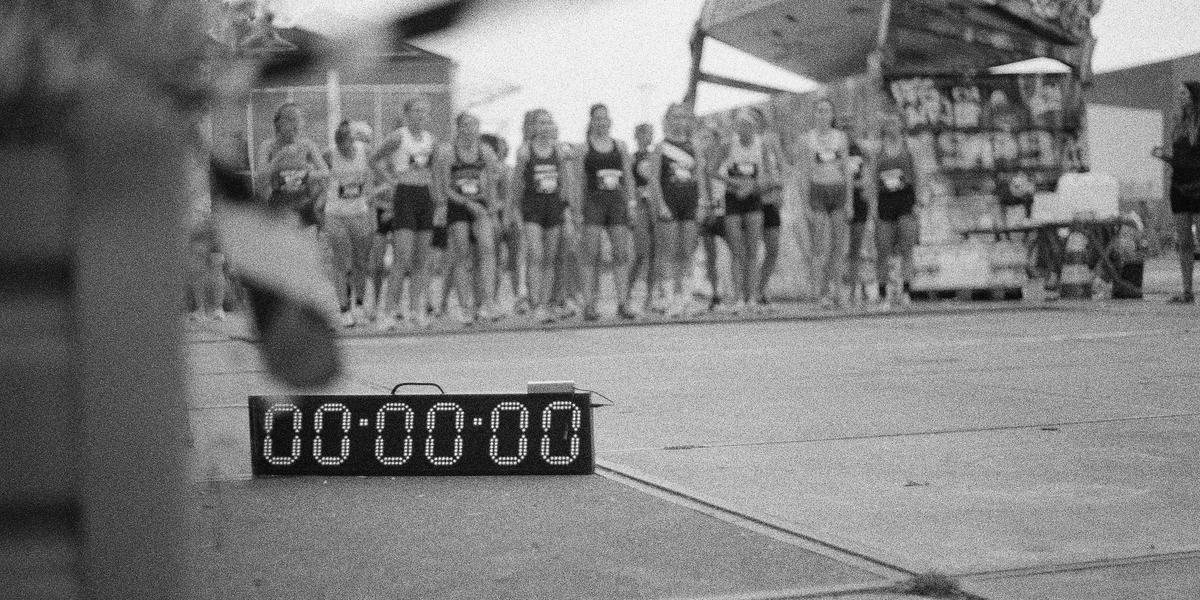
You're on the start line. Weeks of training behind you, nerves jangling, the field bunched around you. The horn sounds, and everyone surges forward. You go with them, because standing still while a crowd sprints away feels impossible. And it feels fine. Easy, even. Your legs are fresh, your breathing's fine, you glance at your watch and you're well ahead of plan.
Then somewhere around halfway, the floor drops out. The pace you were holding so comfortably becomes a fight. The last stretch is damage control. You cross the line having run your first mile fastest and your last mile slowest, and you spend the drive home wondering where the race went.
That's not bad luck and it's not a fitness problem. It's a pacing problem, and it's the single most common way a race gets away from a runner. The good news: it's also one of the most fixable.
Why the first mile lies to you
The first mile of a race is the least trustworthy mile you'll ever run, for a few reasons stacked on top of each other.
Adrenaline is masking your effort. Race-day nerves flood you with the stuff, and it quietly turns down the volume on how hard you're actually working. Your legs are completely fresh, so there's no fatigue yet to give you an honest reading. The crowd is towing you along, human beings are pack animals, and matching the people around you is almost involuntary. And plenty of courses start with a downhill or a wide-open stretch that makes a too-fast pace feel effortless.
Add it up and you get a trap: the pace that feels easy in mile one is not easy. It's just early. The effort hasn't caught up with you yet, and by the time it does, the damage is already done.
What going out too fast actually does
Running too fast early isn't just slightly inefficient. It changes the kind of race your body has to run.
Go out hard and you tip into your harder, less sustainable gears sooner than you should. You start producing lactate faster than you can clear it. You burn through your limited stores of quick-access carbohydrate at a rate you can't keep up. Your body heats up. None of this announces itself in mile one, it shows up as the wall later.
And here's the part runners most need to hear: you cannot bank time. The seconds you gain by going out fast aren't saved, they're borrowed, and the back half of the race charges brutal interest. A handful of seconds gained early routinely costs minutes later. That's the positive split: every mile slower than the one before, the grim arithmetic of a race quietly falling apart.
The race you actually want
The race you're aiming for is the opposite shape. It's called a negative split: the second half run at the same pace as the first, or a touch faster.
Almost every well-run race is paced this way. Almost every blow-up is the reverse. Running the back half strong feels completely different from hanging on, you spend the closing miles passing people instead of being passed, and you finish knowing you raced the whole thing rather than survived it. It's also, reliably, faster overall. Even pacing, or finishing slightly faster than you started, is how nearly every good time gets run.
How to pace the first mile
Know your honest target
Before race day, settle on a realistic goal pace. built from your recent training and runs, not from a number you'd love to see. If you genuinely don't know what you're capable of, don't guess at a pace. Instead, pick an effort: the hardest effort you believe you could hold all the way to the finish. Let the pace be whatever that effort produces.
Line up where you belong
A surprising amount of first-mile damage is done before you've taken a step. Start near the front of the field and you'll spend the opening minute being streamed past by faster runners, with the instinct to chase them almost impossible to switch off. Start too far back and you'll burn energy weaving through slower ones. For most races there's no penalty for being honest: line up in the middle, or towards the back of where you think you belong, and let the quick runners go, they're meant to be ahead of you. Starting in the right place turns the crowd from something that drags you along into something you can simply settle and run within.
Make the first mile feel too easy
This is the whole skill. The first mile should feel held back, almost frustratingly gentle, like you're leaving something on the table. You are, deliberately. Let people stream past you. They are making the mistake you've decided not to make; you don't have to follow them to be running your own race well.
Use one early checkpoint
Glance at your watch at the first kilometre or mile marker. If you're well ahead of target pace, ease off now, not at halfway, not "once I've settled." A pacing error caught in the first mile costs you almost nothing to fix. The same error caught at halfway has already shaped your whole race.
Then run by feel
Once you've settled into a rhythm, let effort lead and treat the watch as a backup. Heat, hills and wind all change what the right pace is on the day, and your watch knows about none of them. Your body does. Trust it.
If you do go out too fast
It happens, even to runners who know all of this. If you realise you've overcooked the start, don't panic and absolutely don't quit. Back the effort right off, let your breathing resettle, and accept that today's time will be whatever it now is. A race run too fast early can still be salvaged into a solid, respectable finish. One bad split is not the whole day. And bank the lesson while it's fresh, almost every runner overcooks a first mile at some point, and the ones who get good at pacing are simply the ones who did it once, hated the back half, and paid closer attention next time. Your first race is allowed to be the one that teaches you this.
The first mile asks for a kind of patience that goes against every instinct on a start line. But that patience is the entire game. Hold back when it's easy to hold back, and you get to run hard when it actually counts, the closing miles, when the runners who went out too fast are coming back to you. Run the first mile like it doesn't matter, and you'll get to enjoy the last one.